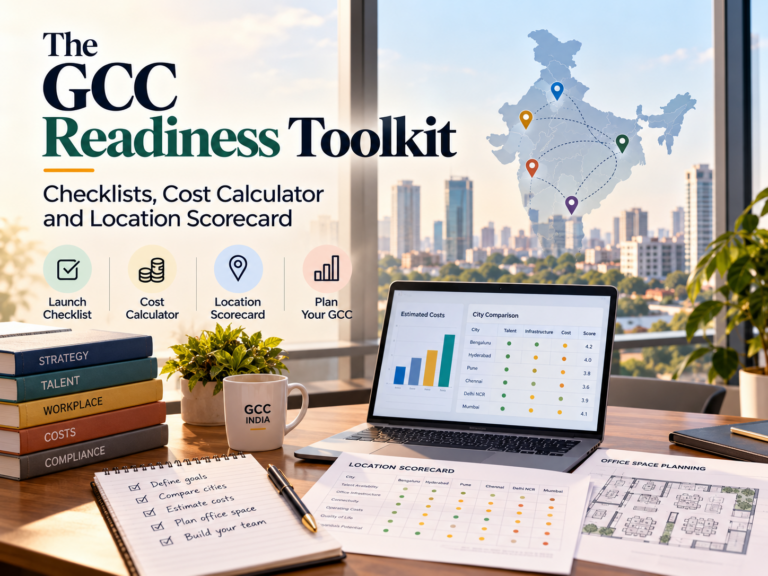
India has become an important destination for global businesses looking to expand their capabilities, access specialised talent and strengthen their international operations. But setting up an operation in India involves more than choosing a city and finding an office. Companies must first decide how they want their India operations to function.
Should you establish a Global Capability Centre (GCC), centralise business functions through a Shared Services Centre (SSC), or outsource selected activities to an external service provider?
Although these models can perform similar tasks, they differ in ownership, management responsibility, decision-making authority and long-term business objectives. Choosing the right structure can influence everything from operating costs and recruitment to intellectual property ownership and the company’s ability to innovate.
The distinction has also become more relevant as GCCs evolve beyond traditional support functions. According to EY’s analysis of GCC operating models in India, modern centres are increasingly taking responsibility for business transformation, technology development and innovation rather than focusing solely on cost efficiency.
This guide compares GCCs, shared services centres and outsourcing to help businesses identify the operating model that best fits their goals in India.
What Is a Global Capability Centre (GCC)?
A Global Capability Centre is an operation established by a multinational company in another country to support, develop or manage capabilities for its wider business.
In India, GCCs are commonly established by international companies to access technology talent, develop products, manage business processes, conduct research and development, and build specialised expertise.
Earlier generations of these centres often focused on reducing operational costs by moving support functions to locations with lower operating expenses. Many modern GCCs have broader responsibilities, including software engineering, artificial intelligence, data analytics, cybersecurity, financial planning, product development and research.
A GCC can begin with a relatively narrow mandate and gradually take on more responsibility as the business expands its operations in India.
How does a GCC operate?
In a traditional captive model, the parent company owns the centre and maintains direct control over its operations. The Indian entity employs its workforce and delivers services or capabilities to the wider organisation.
However, ownership alone does not determine how much authority the centre receives. Some GCCs operate under close headquarters supervision, while others have substantial responsibility for budgets, product development, technology decisions and business outcomes.
For example, a US-based technology company might establish a GCC in Bengaluru to develop software products, manage cloud infrastructure and lead AI research. The Indian team may eventually own entire product modules rather than simply execute tasks assigned by its headquarters.
A GCC is best suited to companies that want to build long-term capabilities and retain direct ownership of strategically important work.
What Is a Shared Services Centre (SSC)?
A Shared Services Centre consolidates similar business functions into a central operation that serves multiple departments, business units, subsidiaries or geographical markets.
Instead of maintaining separate teams for the same activities across different parts of an organisation, a company brings those activities together to improve consistency, efficiency and control.
Common shared services functions include:
- Finance and accounting
- Payroll and human resources administration
- Procurement and vendor management
- Accounts payable and receivable
- Customer support
- Reporting and business administration
- Selected IT support functions
For example, a multinational company operating across 15 countries might consolidate payroll processing, invoice management and employee administration into one centre in India. Rather than each country’s office maintaining a separate team for these activities, the shared services operation follows common processes and service standards.
An SSC can be established as an internal operation owned by the company. It can also use external providers for certain activities.
How does an SSC differ from a GCC?
The distinction lies primarily in the centre’s mandate, not simply its location or legal structure.
An SSC typically focuses on standardising and delivering services across the organisation. A GCC can include shared services, but it may also own product engineering, research, advanced analytics, intellectual property development and other strategic capabilities.
The two terms are not mutually exclusive. A company may establish a GCC that contains a finance shared services function alongside software engineering, cybersecurity and product development teams.
An SSC is particularly useful when a company wants to consolidate recurring business activities, while a GCC can support a broader mandate that includes strategic and specialised capabilities.
What Is Outsourcing?
Outsourcing involves engaging an external company to perform specific functions, processes or services under a commercial agreement.
Instead of building and managing the entire operation internally, a business pays a service provider to deliver agreed outcomes. The provider may supply employees, technology, infrastructure, process expertise or a combination of these.
Common examples include:
- Customer service and contact centre operations
- Payroll processing
- IT helpdesk support
- Software development
- Recruitment administration
- Accounting and bookkeeping
- Data processing and document management
For instance, a European retailer might contract an Indian business process outsourcing provider to manage customer enquiries. The retailer defines service expectations, quality standards and escalation procedures, while the provider manages the delivery team under the contract.
Outsourcing can reduce the need for direct investment in infrastructure, recruitment and day-to-day service delivery. However, the company still needs to manage the vendor relationship, monitor performance and protect sensitive information.
The degree of control depends on the contract, governance arrangements and nature of the service. Outsourcing does not automatically mean losing control of all decisions or intellectual property.
Outsourcing is particularly useful when a company needs external expertise, variable capacity or a defined service without building a dedicated internal operation.
GCC vs Shared Services Centre vs Outsourcing: Key Differences
The following table compares the three models across the factors most likely to influence a company’s decision.
| Comparison factor | GCC | Shared Services Centre | Outsourcing |
|---|---|---|---|
| Ownership | Usually owned by the parent company in a captive model | Often internally owned, but can use external providers | Service delivered by an external provider |
| Primary objective | Build and manage global capabilities | Consolidate and standardise business services | Obtain services or expertise from a third party |
| Management | Internal leadership, with authority depending on the operating model | Internal or provider-managed, depending on structure | Primarily managed by the service provider |
| Workforce | Employees of the GCC’s employing entity in a captive setup | Internal employees or outsourced personnel | Generally employed or contracted by the provider |
| Investment | Typically requires investment in setup, talent, technology and operations | Depends on whether the centre is built internally or externally managed | Often lower upfront infrastructure investment for the client |
| Process control | Direct control in an internally owned model | Strong process oversight, depending on governance | Governed through contracts, service levels and vendor management |
| Intellectual property | Can support direct ownership and development, subject to legal arrangements | Depends on the legal and operational structure | Depends on contracts, applicable law and the work being performed |
| Scalability | Requires internal planning, recruitment and capacity management | Scales through centralised processes and capacity planning | Can scale through the provider, subject to capacity and contract terms |
| Innovation | Can have substantial product, engineering and R&D responsibilities | Usually focused on service improvement, though scope can expand | Depends on the provider’s capabilities and contractual scope |
| Best suited for | Long-term capability building and strategic ownership | Repetitive, cross-functional services requiring consistency | Defined services, specialist expertise and flexible capacity |
The important point is that these are typical characteristics, not rigid rules. A mature shared services centre can drive transformation, a GCC can outsource selected functions, and an outsourcing contract can include substantial innovation responsibilities.
The right comparison should therefore focus on the actual operating arrangements rather than the label attached to them.
Which Model Offers Better Cost Efficiency?
Cost is often one of the first considerations when evaluating an India operating model. However, comparing only employee salaries or vendor charges can produce a misleading picture.
Each model has a different cost structure.
GCC costs
An internally owned GCC may require investment in entity setup, recruitment, leadership, office space, technology, security, compliance and ongoing administration.
The parent company must also account for management overhead, employee retention, training and the time required to establish operations.
These investments can be justified when the company expects sustained demand, needs specialised capabilities or wants greater ownership of its technology and processes.
Shared services costs
An SSC can reduce duplication by consolidating similar activities into one operation. For example, a central finance team can process invoices for multiple business units using standardised workflows and common technology.
However, the company must consider implementation expenses, systems integration, governance, change management and the ongoing cost of maintaining the centre.
Savings depend on the volume of work consolidated and the extent to which processes can be standardised.
Outsourcing costs
Outsourcing can reduce upfront investment because the provider already has infrastructure, employees and operational processes.
The total cost may include service fees, implementation charges, transition expenses, contract management, change requests and additional services outside the agreed scope.
Companies should also evaluate the cost of transferring work back in-house or moving it to another provider if the arrangement no longer meets their requirements.
How should businesses compare the costs?
A useful approach is to calculate the total cost of ownership over a consistent period, such as three to five years.
Include:
- Initial setup and transition expenses.
- Recruitment, salaries, benefits and training.
- Office rent, fit-outs, utilities and facilities management.
- Technology, software licences, infrastructure and cybersecurity.
- Legal, tax, compliance and administrative expenses.
- Vendor fees, internal oversight and contract management.
- Business continuity, expansion and eventual exit costs.
Use the same workload, service requirements, quality standards and planning horizon for every model. Otherwise, a comparison may make one option appear cheaper simply because it excludes expenses that another option includes.
There is no universally cheapest model. A GCC may offer better long-term economics for sustained, high-volume or strategically important work, while outsourcing may be more practical for a specialist requirement or an operation with uncertain demand.
Control, Talent and Intellectual Property: What Should Companies Consider?
Cost efficiency is only one part of the decision. The level of control a company needs over its people, processes, data and technology can be equally important.
1. Control over operations
A GCC gives the parent company the opportunity to establish its own management structure and operating policies. However, the level of autonomy must be deliberately defined.
A centre that requires headquarters approval for every significant decision may have less operational flexibility than a well-governed centre with clearly delegated authority.
An SSC also allows a company to maintain internal control over shared processes, provided the relevant functions remain internally managed.
With outsourcing, control is exercised through contractual obligations, performance measures, audit rights, governance meetings and escalation mechanisms.
2. Access to specialised talent
A GCC can be attractive when a business needs to build a dedicated team with deep knowledge of its products, systems or industry.
This is particularly relevant for engineering, AI, data science, cybersecurity and research-intensive functions.
An SSC may prioritise skills in finance, HR, procurement, administration and process improvement.
Outsourcing can provide access to specialist skills without requiring the client to recruit every role directly. However, availability, continuity and the provider’s ability to retain key personnel should be evaluated.
3. Intellectual property and data security
Companies should determine who owns work products, software, inventions, documentation, datasets and other intellectual property created during the engagement.
An internally owned GCC can provide a clear framework for assigning intellectual property to the relevant company, but ownership must still be established through appropriate employment agreements, contracts and legal arrangements.
Shared services structures require similar clarity where employees develop processes, tools or other assets.
Outsourcing agreements should explicitly address intellectual property ownership, licensing rights, confidentiality, data access, subcontracting, security controls and the handling of information when the contract ends.
For companies handling sensitive data or regulated activities, the operating model should also be assessed against applicable Indian laws, sector-specific obligations and the requirements of the company’s home jurisdiction.
Can a Company Combine a GCC, Shared Services and Outsourcing?
Yes. In fact, combining these models can be a practical way to balance control, expertise and flexibility.
A company does not necessarily have to choose one model for every function.
Consider a multinational financial services business planning to expand its Indian operations.
It might establish a GCC to manage technology development, cybersecurity, data analytics and selected risk functions. Within that centre, a shared services team could consolidate finance administration and HR operations for multiple international business units.
The company could then outsource routine IT helpdesk support or selected administrative activities to an external provider.
This structure allows the organisation to retain direct ownership of critical capabilities while using specialist partners for work that does not require the same level of internal involvement.
A hybrid approach can also help a business establish its initial presence more quickly while developing the leadership, systems and internal capabilities needed for future expansion.
However, combining models requires clear accountability. Companies should define which team owns each process, who can access sensitive information, how service providers interact with internal teams, and who is responsible for resolving problems.
Without clear boundaries, overlapping responsibilities can create operational gaps rather than efficiencies.
How to Choose the Right Operating Model for Your Business
Before selecting a model, companies should evaluate their long-term objectives, the nature of the work and their readiness to manage operations directly.
Choose a GCC if:
- You want to build a long-term presence in India.
- The work involves proprietary technology, specialised knowledge or strategically important processes.
- You need direct oversight of recruitment, operating standards and capability development.
- Your organisation expects sustained demand that justifies investment in an internal operation.
- You want the option to expand into product ownership, R&D, advanced analytics or global decision-making.
Choose a shared services centre if:
- Multiple business units perform similar administrative or operational activities.
- You want to reduce duplication and standardise processes.
- Your priority is consistent service delivery across departments or countries.
- The functions can be consolidated without undermining necessary local responsibilities.
- You want centralised reporting, governance and process improvement.
Choose outsourcing if:
- You need a defined service without establishing an entire internal operation.
- The work requires specialist expertise or temporary additional capacity.
- Your workload fluctuates and you need flexibility.
- A provider can deliver the required service under acceptable cost, quality and security conditions.
- You can define measurable service expectations and manage the associated vendor relationship.
A simple decision framework
| Business requirement | Model to evaluate first |
|---|---|
| Long-term ownership of products, engineering or specialised capabilities | GCC |
| Consolidation of finance, HR or procurement across business units | Shared Services Centre |
| A defined service that can be delivered by an external specialist | Outsourcing |
| Strategic capabilities combined with flexible external support | Hybrid model |
| Standardised internal processes with opportunities for automation | Shared Services Centre or GCC |
These are starting points, not automatic recommendations. A company’s industry, regulatory environment, available capital, expected workload and internal management capabilities can change the outcome.
What Does the Choice Mean for Office Space in India?
Once the operating model is clear, companies can begin evaluating the infrastructure required to support it.
A GCC may need dedicated office space, secure access controls, reliable connectivity, backup power, meeting rooms, collaboration areas and room for future expansion. The exact requirements depend on the centre’s functions and security obligations.
A shared services centre may place greater emphasis on standardised workstations, process-driven layouts, technology infrastructure and efficient use of office space.
Outsourcing may reduce the client’s need to provide physical infrastructure when the provider operates from its own premises. However, the client may still need office space for internal oversight, transition teams, vendor collaboration or other functions.
For a new GCC, the choice between a traditional lease, a managed office and flexible workspace can also influence the initial investment and speed of setup.
A traditional lease may offer greater control over the premises but can involve fit-out expenses and longer commitments. A managed office may provide a more ready-to-use environment with facilities support, while flexible workspace can help accommodate an initial team or temporary expansion.
These options should be assessed against headcount, security requirements, customisation needs, contract terms and the expected growth of the operation.
Businesses comparing locations can explore Flexo’s GCC setup guide for India and relevant workspace listings to understand the next steps in planning their office requirements.
Frequently Asked Questions
1. Is a GCC the same as a shared services centre?
No. A shared services centre consolidates and delivers common business functions across an organisation. A GCC can include shared services but may also manage product engineering, research, technology development and other strategic capabilities. The scope depends on the company’s operating model.
2. Is a GCC better than outsourcing?
Neither model is universally better. A GCC can offer greater direct ownership of people, processes and capabilities, while outsourcing can provide specialist expertise and flexible capacity without requiring the client to build the entire operation internally. The right choice depends on strategic importance, cost, risk and expected demand.
3. Can a company outsource work while operating a GCC in India?
Yes. A company can retain strategic and specialised functions within its GCC while outsourcing selected services to external providers. Clear contracts, security controls, accountability and service-level expectations are important for making the arrangement work.
4. Is a shared services centre always part of a GCC?
No. A shared services centre can operate as a standalone internal unit, an outsourced arrangement or a function within a broader GCC. The organisational structure depends on how the company chooses to manage its services.
5. Which model requires the highest initial investment?
An internally established GCC can require substantial initial investment in entity setup, recruitment, leadership, technology, infrastructure and workplace arrangements. However, the actual cost depends on the size and scope of the operation. An internally established SSC can also require significant investment, while outsourcing often reduces the client’s upfront infrastructure requirements.
6. Can a company start with outsourcing and later establish a GCC?
Yes. A company may use an external provider to establish an initial operational presence, develop market knowledge and support early-stage requirements before building an internal centre. However, a transition requires careful planning around employee transfers, contracts, intellectual property, data access, process documentation and business continuity. The feasibility depends on the original agreement and applicable legal requirements.
7. What should a company evaluate before setting up a GCC in India?
Key considerations include the business case, target functions, legal structure, talent availability, location, office requirements, technology infrastructure, data security, tax and regulatory obligations, and a realistic expansion plan. Companies should define the centre’s mandate and decision-making authority before committing to a location or operating structure.
Final Thoughts
Choosing between a GCC, a shared services centre and outsourcing is ultimately a decision about how a company wants to build and manage its capabilities.
A GCC can support long-term capability development and direct ownership. A shared services centre can improve consistency and efficiency by consolidating business functions. Outsourcing can provide access to expertise and flexible capacity without requiring the same level of direct operational investment.
For many businesses, the answer may involve a combination of all three.
Companies planning to establish a GCC in India should begin by defining the capabilities they want to build, the level of control they need and the scale of their long-term operations. Those decisions can then guide the choice of operating model, location and workplace strategy.
Once the model is established, the next step is to compare Indian business hubs, evaluate office requirements and build a practical setup plan that supports both the initial launch and future growth.
Planning to establish a GCC in India? Explore Flexo’s complete GCC setup guide to understand the broader setup process, location considerations and workplace decisions.