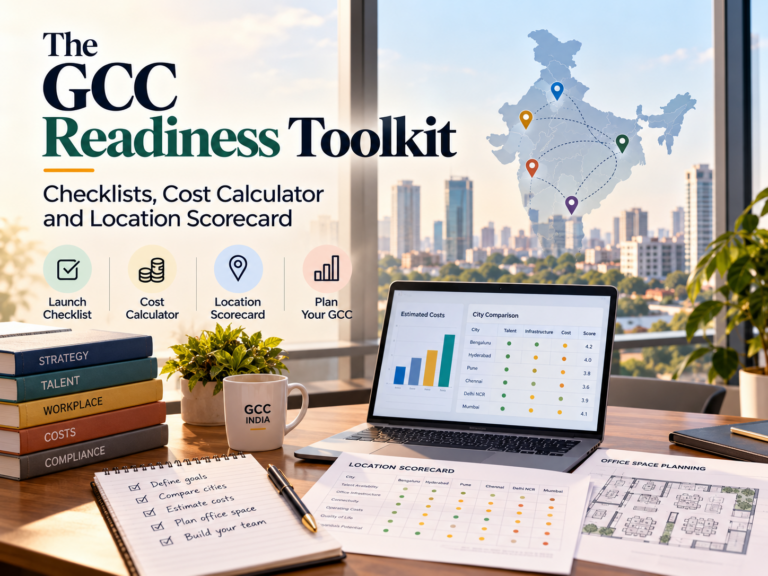
Choosing a city is one of the first major decisions involved in setting up a Global Capability Centre (GCC) in India. However, the decision should not end at the city level.
Two business districts in the same city can offer very different experiences in terms of employee commute, access to talent, office availability, infrastructure and occupancy costs. A location that looks attractive on a city-wide comparison may not be suitable for a particular team.
This is why GCC location planning should move from a broad city shortlist to a detailed micro-market assessment.
A micro-market is a specific commercial district or cluster within a city. Examples include Outer Ring Road and Whitefield in Bengaluru, HITEC City and the Financial District in Hyderabad, and Gurugram’s major office districts within Delhi NCR.
The right micro-market should support the GCC’s functions, recruitment plans, workplace requirements and expected growth. It should also fit the company’s operating budget.
For an initial city-level comparison, read Best Cities in India to Set Up a GCC: A Comparative Guide.
Why Does Micro-Market Selection Matter?
A GCC’s location influences more than its monthly office rent. It can affect hiring, employee retention, daily commuting, access to business partners and the practicalities of expanding the operation.
A district with a strong technology ecosystem may be attractive to a software engineering team. A centre focused on financial services may prioritise access to relevant industry networks. A business with a large hybrid workforce may place greater emphasis on transport connectivity and office utilisation.
Micro-market selection helps companies identify these differences before signing a lease or committing to a workplace.
The assessment should consider the following factors.
1. Start With the GCC’s Functional Requirements
The right location depends on what the centre will do.
A GCC focused on software engineering, AI or product development may prioritise access to specialised technical talent. A finance and accounting centre may focus on professionals with relevant financial operations experience. An engineering or manufacturing technology centre may benefit from proximity to relevant industrial and technical ecosystems.
Before shortlisting business districts, document:
- The functions the GCC will manage
- The skills and experience levels required
- The expected initial headcount
- The hiring plan for the next two to three years
- The need for specialist infrastructure or secure work areas
- The frequency of travel by employees and business stakeholders
This information creates a practical basis for comparing locations.
For a wider view of the differences between established hubs, read Bengaluru vs Hyderabad vs Pune: Which GCC Location Offers the Best Value?.
2. Evaluate Talent Availability Within the Commute Catchment
A city may have a large workforce, but that does not mean every business district is equally convenient for employees.
Companies should consider where prospective employees live, how they travel to work and whether the proposed office location is practical for the workforce they intend to recruit.
A micro-market with suitable buildings but difficult commuting options may create challenges for recruitment and attendance.
Evaluate:
- Availability of relevant professionals within a practical commuting distance
- Access to public transport and major roads
- Typical commute times from important residential areas
- Availability of transport options for employees working late shifts
- Proximity to universities or specialist talent clusters, where relevant
- Competition from nearby employers recruiting similar professionals
The objective is not simply to choose a district with a large workforce nearby. It is to find a location that supports the company’s actual recruitment plan.
3. Compare Office Costs Beyond the Quoted Rent
Office rent is an important part of the decision, but it should not be treated as the total cost of occupancy.
The financial assessment should include the costs associated with securing, preparing and operating the workplace.
Depending on the property and agreement, these may include:
- Monthly rent
- Common area maintenance charges
- Security deposits and other upfront commitments
- Fit-out and furniture expenses
- Power, connectivity and backup infrastructure
- Facilities management
- Parking and transport arrangements
- Restoration or exit-related obligations
Companies should compare premises using consistent assumptions. A fitted managed office and a bare-shell traditional lease, for example, may have very different cost structures even when their quoted rates appear similar.
The comparison should reflect the expected headcount, required facilities, contract duration and cost of preparing the premises for occupation.
For a broader overview of the setup and workplace decisions involved, see The Complete Guide to Setting Up a Global Capability Center in India.
4. Assess Connectivity and Employee Commute
Connectivity affects both employee experience and business operations.
A micro-market should be assessed against the travel patterns of the people who will use the office, rather than simply its distance from a major transport hub.
Consider:
- Access to metro or other public transport, where available
- Road connectivity from major residential areas
- Travel time to the airport for teams with frequent business travel
- Availability of parking
- Traffic conditions during typical working hours
- Accessibility for visitors and external stakeholders
Airport proximity may be important for senior leaders or teams that travel regularly. For a large employee base, everyday commuting may have a greater influence on the location decision.
Companies should identify the needs of different employee groups and assess how the shortlisted locations perform against them.
5. Check Building Quality and Technical Infrastructure
Not every commercial building will meet a GCC’s operational requirements.
A centre handling sensitive information or specialised technology workloads may require stronger access controls, reliable power backup, dedicated network infrastructure or restricted work areas.
The building assessment should cover:
Power and connectivity: Confirm the availability and reliability of power supply, backup systems and telecom connectivity.
Security: Review access controls, visitor management, surveillance and the ability to implement company-specific security policies.
Building operations: Evaluate lifts, HVAC, fire safety, maintenance standards and facility management.
Workplace suitability: Check whether the floor plate, meeting rooms, collaboration areas and support facilities can accommodate the planned team.
Expansion capacity: Establish whether the building or nearby properties can support additional space if headcount increases.
These checks should be completed before a property is selected, particularly when the GCC has specific compliance or technical requirements.
6. Compare Office Models Within Each Micro-Market
The best micro-market and the best workplace model are related decisions, but they are not the same.
A company may find a suitable location but still need to decide whether to take a traditional lease, use a managed office or begin in a flexible workspace.
Traditional lease
A traditional lease may suit a company with a confirmed long-term headcount plan and requirements for greater control over design, branding, infrastructure and security.
However, the business should account for fit-out costs, lease commitments, building readiness and future expansion requirements.
Managed office
A managed office may be appropriate for a company that wants a dedicated workplace with facilities and operational support.
The company should assess the services included, customisation options, security arrangements, contract terms and cost of expansion.
Flexible workspace
Flexible workspace can help a company accommodate an initial team, a pilot operation or a phased hiring plan.
It may also provide temporary capacity while a permanent office is being prepared. The provider must still meet the company’s requirements for confidentiality, connectivity, access control and infrastructure.
The decision should reflect the GCC’s headcount, timeline, security requirements and long-term operating model.
For more on how India’s GCC landscape is evolving, see GCC Trends in India 2026: Market Size, Hiring, Expansion and Office Demand.
7. Plan for Future Expansion
A location that works for the first 50 employees may not be suitable when the GCC expands to several hundred employees.
Before committing to a micro-market, consider whether it can support the centre’s likely growth. This includes the availability of additional office space, the depth of the talent pool and the ability to recruit for new functions.
Companies should assess:
- Planned headcount over the next two to three years
- The likely timing of additional hiring
- The availability of larger or adjoining office premises
- Whether the building can accommodate technical and security requirements as the centre grows
- The flexibility of the proposed contract
- The possibility of using additional locations if necessary
Expansion should be treated as a planning requirement, not an afterthought. A workplace strategy that accounts for growth can reduce the risk of premature relocation or excess capacity.
8. Use a Weighted Micro-Market Scorecard
A structured scorecard helps companies compare locations using the same criteria.
The weight assigned to each factor should reflect the GCC’s mandate. A technology research centre may prioritise specialist talent and technical infrastructure, while a business services centre may place greater emphasis on recruitment capacity, commute options and total occupancy cost.
| Evaluation factor | Questions to consider |
| Talent availability | Can the location support hiring by role, experience and scale? |
| Recruitment | Are hiring timelines and compensation assumptions realistic? |
| Connectivity | Can employees and business visitors reach the office conveniently? |
| Occupancy cost | What is the total cost, including rent, maintenance and setup? |
| Building infrastructure | Does the property meet technical and operational requirements? |
| Security | Can the location support the company’s security policies? |
| Office availability | Is suitable space available for the planned headcount? |
| Expansion | Can the centre grow without a disruptive relocation? |
| Workplace model | Does a lease, managed office or flexible workspace best fit the requirement? |
Score each shortlisted micro-market against the criteria and document the evidence behind each rating. This makes the final recommendation easier to explain to leadership and helps identify assumptions that need further validation.
9. Common Micro-Market Selection Mistakes
Companies can avoid unnecessary costs and delays by watching for a few common mistakes.
Choosing based only on rent: A lower quoted rate does not guarantee lower total occupancy costs or easier recruitment.
Ignoring employee commute patterns: An office may be centrally located but inconvenient for the people the company needs to hire.
Selecting a building before defining requirements: Technical infrastructure, security and floor-plate needs should be established before property selection.
Underestimating expansion: A location that cannot accommodate future growth may force the company to relocate earlier than planned.
Treating the whole city as one market: Conditions can differ significantly between business districts within the same city.
Overlooking workplace models: A traditional lease is not necessarily the best option for every stage of a GCC’s development.
Frequently Asked Questions
What is a micro-market in commercial real estate?
A micro-market is a specific commercial district or cluster within a city. Different micro-markets may vary in office costs, transport connectivity, building quality, talent access and availability of space.
How should a company choose a GCC micro-market?
Start by defining the GCC’s functions, headcount and infrastructure requirements. Compare shortlisted districts on talent availability, commute patterns, total occupancy costs, building quality, security and expansion capacity.
Should office rent be the main selection criterion?
No. Rent is one factor in the total cost of operating a GCC. Companies should also account for recruitment, commuting, fit-out, maintenance, technology and future expansion.
Is a managed office suitable for a GCC?
A managed office may suit companies that need a dedicated workplace with operational support. Its suitability depends on cost, security, customisation, contract terms and the company’s growth plans.
How early should companies plan for expansion?
Expansion planning should begin before the initial office is selected. Companies should evaluate expected headcount growth and the availability of additional space in the chosen micro-market.
Conclusion
Choosing a GCC micro-market requires more than identifying a popular business district or comparing rental rates. Companies need to understand their workforce, operational requirements, building needs and future expansion plans before making a decision.
A structured assessment helps businesses compare locations consistently and select a workplace that supports both immediate operations and long-term growth.
Planning your GCC location? Explore Flexo’s GCC resources to compare Indian markets, workplace models and the decisions involved in establishing a centre.