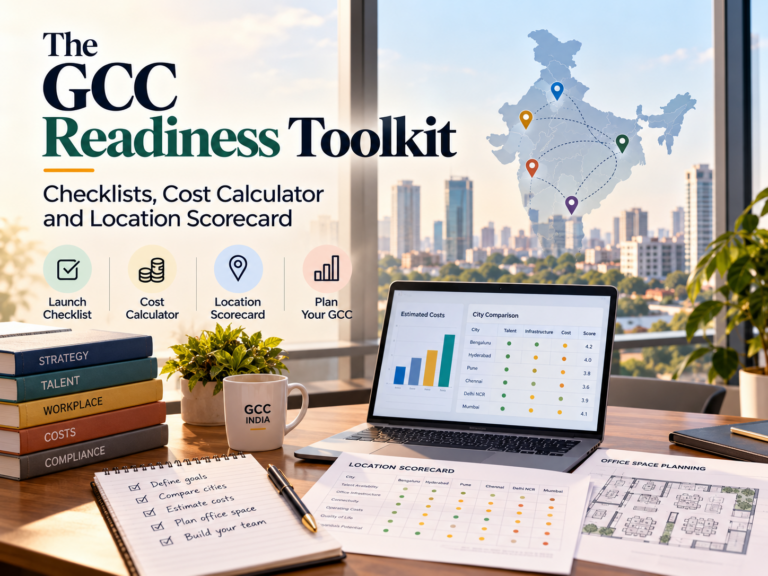
India has become an important destination for Global Capability Centres (GCCs), but establishing a centre is only the first step. Its long-term success depends on whether the company can attract the right people, develop specialist skills and retain employees as the business grows.
A GCC focused on finance operations will have different hiring requirements from one building AI products, cybersecurity capabilities or global engineering teams. A talent strategy must therefore begin with the business mandate, not simply with a target headcount.
This guide explains how global companies can plan hiring, select a location, structure their workforce and build a sustainable talent pipeline in India.
1. Define the GCC’s talent requirements
Before recruiting, identify what the centre is expected to deliver. This decision determines the roles, experience levels and skills required during the initial phase.
Common GCC functions include:
- Technology and product engineering: Software developers, cloud engineers, product managers and quality engineers.
- Data and artificial intelligence: Data engineers, analytics professionals, AI specialists and machine learning engineers.
- Finance and business operations: Accountants, financial analysts, controllers and process specialists.
- Cybersecurity: Security analysts, cloud security engineers and risk professionals.
- Research and development: Domain specialists, engineers and research professionals.
- Enterprise support: HR, procurement, legal operations and customer experience teams.
Separate essential launch roles from positions that can be introduced later. A smaller team with the right leadership and specialist capabilities may be more useful during the launch phase than a large team recruited before its responsibilities are clear.
For an overview of the broader setup process, see https://www.flexospaces.com/resources/the-complete-guide-to-setting-up-a-global-capability-center-in-india/.
2. Choose a city based on talent availability
The best GCC location depends on the roles being recruited, the depth of the local talent pool and the ability to attract employees over time.
| Location | Potential talent strengths | Considerations |
| Bengaluru | Technology, AI, product engineering and startups | Competition for experienced technology professionals |
| Hyderabad | Technology, enterprise platforms, engineering and life sciences | Competition varies by specialist role and micro-market |
| Pune | Engineering, automotive technology, SaaS and IT | Specialist availability depends on the function |
| Chennai | Manufacturing engineering, automotive, technology and operations | Assess the supply of niche digital and leadership skills |
| Mumbai | Banking, financial services, analytics and corporate functions | Higher office and living costs may affect workforce planning |
| Delhi NCR | Technology, consulting-related roles, business operations and enterprise functions | Hiring conditions vary across Gurugram, Noida and Delhi |
| Selected Tier II cities | Potential opportunities in engineering, operations and regional talent development | Validate the depth of specialist talent before committing |
These are broad indications, not guarantees of talent availability. Companies should test each market against actual job descriptions, salary expectations and hiring timelines.
For a wider city comparison, read https://www.flexospaces.com/resources/best-cities-in-india-to-set-up-a-gcc-a-comparative-guide/.
3. Build a phased hiring plan
Recruitment should follow the GCC’s operating milestones. Hiring too early can increase costs before teams have the infrastructure and responsibilities needed to work effectively. Hiring too late can delay delivery and put pressure on existing employees.
A phased plan can look like this:
Phase 1: Establish leadership and core capabilities
Recruit the centre head or site leader, functional managers, technical leads and essential compliance or operations personnel. These employees help establish processes, hiring standards and working relationships with global teams.
Phase 2: Recruit the first delivery teams
Hire the employees needed for the initial business mandate. Prioritise roles that are essential to delivering the first set of projects or services.
Phase 3: Expand based on workload
Add teams as projects, service requirements and approved budgets increase. Review whether existing employees can be trained for new responsibilities before recruiting externally.
Phase 4: Develop specialist capabilities
Once operations stabilise, consider building advanced capabilities in areas such as AI, automation, data science, product ownership or research and development, where these align with the global business strategy.
The timing and size of each phase will depend on the operating model, business requirements and hiring conditions.
4. Benchmark compensation beyond base salary
Salary is an important factor, but compensation planning should account for the entire employment proposition.
Assess:
- Base salary and variable pay
- Benefits and insurance
- Joining incentives, where appropriate
- Learning and certification budgets
- Career progression and promotion pathways
- Work arrangements and commute requirements
- Opportunities to work on global products and strategic projects
Compensation benchmarks should be specific to the role, seniority and city. A generic national salary estimate may not accurately reflect the cost of hiring a specialist engineer or senior finance leader in a particular market.
Review the budget regularly as recruitment progresses. If offers are repeatedly rejected, investigate whether compensation, role expectations, location or the candidate experience is contributing to the problem.
5. Treat retention as part of the hiring strategy
Recruitment costs do not end when an employee joins. Frequent departures can disrupt projects, reduce institutional knowledge and force teams to repeat the hiring and onboarding process.
GCC leaders can strengthen retention by providing clear career paths, regular feedback, access to learning and meaningful ownership of work. Employees should understand how their roles contribute to global outcomes rather than seeing the centre as a support function with limited influence.
Managers should also monitor workload, internal mobility, promotion patterns and employee feedback. Exit interviews can help identify recurring issues, although they should be considered alongside broader workforce data.
Retention strategies need to reflect the workforce. Early-career employees may value structured development, while experienced specialists may prioritise autonomy, technical challenges or leadership opportunities.
6. Develop an internal skills pipeline
External hiring alone may not be sufficient for a growing GCC. Companies should identify which skills can be developed internally and create structured learning pathways.
A practical approach includes:
- Map current skills against the capabilities required over the next 12 to 24 months.
- Identify roles where demand is growing faster than available internal expertise.
- Build learning plans using training, certifications, mentoring and project-based experience.
- Track whether employees apply new skills to actual business work.
- Review the skills map as the GCC’s responsibilities evolve.
Universities, technical institutions and specialist training providers may also support early-career recruitment. Partnerships should be evaluated for the quality of candidates and relevance of the curriculum rather than the number of participants alone.
7. Connect talent planning with workspace planning
Workforce growth affects office requirements, but the relationship is not always one employee to one desk. Hybrid attendance, shift patterns, collaboration needs and security requirements can change the amount and type of space required.
A GCC expecting gradual growth may begin in a managed office or flexible workspace and reassess its needs as hiring becomes more predictable. A larger operation with stable long-term headcount may evaluate a traditional lease alongside flexible capacity.
Workspace planning should account for team adjacency, confidential work, meeting rooms, technical infrastructure and likely peak attendance. Review the space plan whenever the hiring forecast changes materially.
For practical guidance on estimating office requirements, see https://www.flexospaces.com/resources/how-much-office-space-does-a-gcc-need-a-headcount-based-planning-guide/.
8. Measure whether the talent strategy is working
Headcount alone does not show whether a GCC is building the capabilities it needs. Track a balanced set of recruitment, workforce and business measures.
Useful indicators include:
- Time to fill critical positions
- Offer acceptance rate
- New-hire retention
- Voluntary attrition
- Training completion and skills development
- Internal promotions and mobility
- Vacancy levels in specialist roles
- Workforce costs against the approved budget
- Delivery quality and stakeholder satisfaction
Set targets based on the GCC’s function and stage of development. Compare performance over time and investigate the causes behind changes instead of treating any single metric as a complete picture.
Frequently asked questions
Which Indian city is best for GCC hiring?
There is no universal answer. Bengaluru and Hyderabad offer broad technology ecosystems, while Pune and Chennai have strengths in engineering and technology. Mumbai may suit financial services functions, and Delhi NCR offers a diverse enterprise talent base. The final choice should reflect the roles and hiring targets.
Should a GCC hire its entire team before launch?
Usually, hiring is more manageable when phased around operational milestones. Leadership and critical launch roles should be prioritised, with additional recruitment linked to approved demand.
How can a GCC reduce employee attrition?
Clear career progression, competitive role-specific compensation, effective managers, meaningful work and learning opportunities can support retention. Companies should identify the actual causes of attrition before selecting interventions.
Should GCCs recruit only experienced professionals?
No. A mix of experienced specialists and early-career employees can help balance immediate delivery requirements with longer-term talent development.
Conclusion
A successful GCC talent strategy combines business planning, location selection, phased recruitment, skills development and retention. Companies that define the centre’s mandate before hiring are better positioned to build teams that can grow with the business.
Talent and workspace planning should also move together. The right hiring strategy can help a GCC scale its capabilities without committing prematurely to a workforce or office footprint that it cannot sustain.