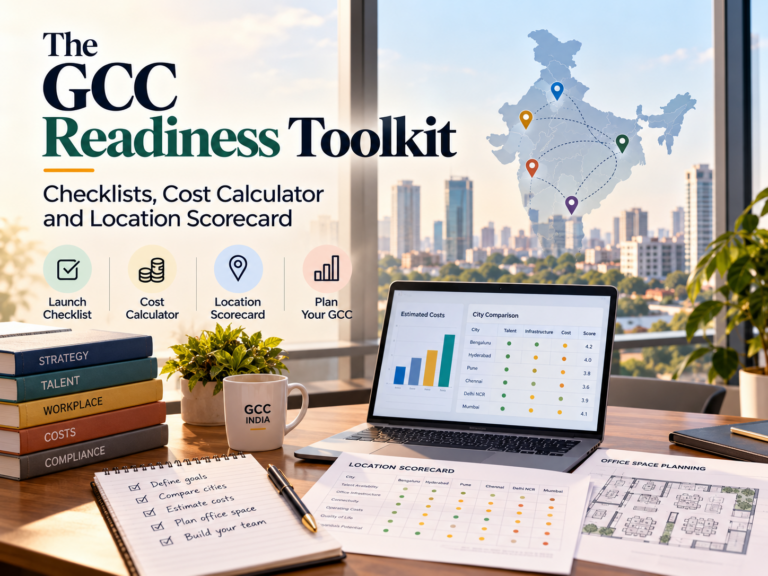
India has become a strategic home for global engineering, business transformation and specialised operations, not just a lower-cost delivery location. This guide separates the credible 2026 evidence from the marketing narrative, then translates it into decisions on talent, governance and workplace strategy.
The short answer
– India’s advantage combines talent, capability depth, industrial ecosystems and scale.
– High-value roles and AI talent require city- and skill-specific diligence.
– The right workplace must work for the first team and the next growth phase.
Introduction
India’s role in the global business landscape is changing. What once attracted multinational companies primarily through cost advantages and access to a large workforce has evolved into something more strategic. Today, global businesses are increasingly turning to India to develop technology, build products, strengthen research capabilities and manage critical business functions.
Global Capability Centres (GCCs) are at the heart of this transformation.
In its 2026 GCC Landscape Report, published in collaboration with Zinnov, NASSCOM reported that India had 2,117 GCCs operating across 3,728 units, employing approximately 2.36 million professionals and generating $98.4 billion in market revenue in FY2026. The number of GCCs has grown by 32% since FY2021, reflecting the country’s expanding role in global enterprise operations.
These figures indicate that GCCs are no longer simply an extension of a company’s back-office operations. Increasingly, they are becoming integral to product development, artificial intelligence, research, cybersecurity and enterprise-wide decision-making.
But what makes India an attractive destination for multinational companies in 2026? Is it the availability of skilled professionals, the cost advantage, the technology ecosystem, or a combination of several factors?
Let’s examine the major reasons behind India’s growing GCC ecosystem and what they mean for businesses planning their own centres.
1. India’s GCC Market Is Expanding Beyond Traditional Support Functions
One of the biggest reasons global companies are investing in India is the changing role of GCCs themselves.
Historically, many centres focused on activities such as transaction processing, customer support, finance administration and routine IT services. These functions helped multinational companies improve efficiency while reducing operating expenses.
Today, the scope is considerably broader.
Companies increasingly establish GCCs to manage software engineering, product development, data analytics, artificial intelligence, cybersecurity, research and development, and specialised business functions.
According to the NASSCOM–Zinnov GCC Landscape Report for 2026, India’s GCC ecosystem generated $98.4 billion in market revenue in FY2026, with 2.36 million professionals working across the sector.
The expansion reflects a broader shift in how multinational companies view their Indian operations. Instead of measuring success only through cost savings or the number of processes handled, businesses are increasingly evaluating the value their centres create for the global organisation.
For example, an Indian GCC might initially support software maintenance before taking responsibility for developing new product features, managing cloud infrastructure or building AI-enabled business solutions.
This evolution gives companies a reason to invest in India beyond routine service delivery.
2. Access to a Large and Diverse Talent Pool
Talent availability remains one of India’s strongest advantages.
Global businesses need professionals who can work across technology, finance, engineering, analytics, cybersecurity and specialised industry functions. Building these teams in a single market can be challenging, particularly when companies need to scale quickly or recruit for emerging technical roles.
India offers a substantial workforce across established technology hubs, supported by universities, engineering institutions, management schools and a mature IT services ecosystem.
This creates several advantages for companies establishing GCCs.
First, businesses can recruit across a range of experience levels, from early-career professionals to senior specialists and experienced leaders.
Second, the existing technology and services ecosystem provides access to professionals who have worked with international clients, enterprise systems and large-scale business operations.
Third, companies can build multidisciplinary teams within the same location. A GCC may bring together software engineers, product managers, data scientists, finance specialists and cybersecurity professionals to work on interconnected business objectives.
However, the size of India’s workforce should not be confused with unlimited availability of every skill. Demand for experienced AI engineers, senior technology leaders, niche research professionals and other specialised roles can be competitive.
Companies must therefore evaluate talent availability at the city and role level rather than assuming that every Indian market offers the same recruitment advantages.
For businesses planning a GCC, the key question is not simply how many professionals are available in India. It is whether the right combination of skills, experience and leadership can be recruited and retained in the chosen location.
3. Artificial Intelligence Is Changing the GCC Business Case
Artificial intelligence has become an important driver of GCC expansion.
Companies are no longer looking only for teams that can maintain existing systems or support established processes. They also need professionals who can develop AI applications, build data infrastructure, automate workflows and integrate intelligent systems into business operations.
India is increasingly being used for these capabilities.
The NASSCOM–Zinnov 2026 report identifies AI as a major force reshaping the GCC landscape. Reporting on the findings, The New Indian Express noted that more than 1,200 Indian GCCs had embedded AI and machine learning capabilities, supported by more than 250 centres of excellence and approximately 250,000 AI professionals.
The report also indicated that nearly half of the GCCs established since FY2021 were built with AI as a core focus from the outset.
These developments suggest that AI is becoming part of the initial design of new centres rather than being treated only as an additional capability introduced later.
A company establishing an AI-focused GCC might use its Indian team to develop machine learning models, build enterprise data platforms, automate internal processes or support AI-powered products used across global markets.
The business opportunity extends beyond creating AI tools. GCC teams can also help companies evaluate use cases, improve data quality, integrate AI into existing systems and monitor how these solutions perform in real-world environments.
Nevertheless, AI capability requires more than access to technical talent. Companies must also invest in data governance, infrastructure, security, responsible AI practices and continuous employee development.
For multinational businesses, the attraction lies in building these capabilities within an operation that can contribute directly to global technology and transformation priorities.
4. Cost Efficiency Without Compromising Strategic Capabilities
Cost remains an important consideration when companies evaluate India, although the discussion has become more nuanced.
Compared with many established business markets, India can offer competitive operating costs across several functions. These may include employee compensation, technology operations, business support and certain aspects of office occupancy.
For a multinational company, the difference can create an opportunity to build a larger or more specialised team within an allocated budget.
However, the real value of a GCC should not be assessed through salary comparisons alone.
A company must consider the full cost of operating the centre, including recruitment, training, leadership, technology, compliance, office space, infrastructure and employee retention.
There are also costs associated with establishing an entity, transferring processes, coordinating with headquarters and developing the systems required to support global operations.
Even after these expenses are included, India can offer an attractive combination of cost efficiency and access to specialised skills.
The more important change is how companies use the resulting advantage.
Instead of simply hiring more people to perform routine tasks, businesses can invest in automation, advanced engineering, product development and higher-value capabilities.
For example, a company might establish an Indian team to support both day-to-day technology operations and the development of new digital products. This allows the centre to contribute to operational efficiency while also supporting future business growth.
The business case becomes stronger when cost savings are combined with measurable improvements in productivity, innovation, service quality and speed of execution.
5. A Mature Technology and Business Services Ecosystem
India’s GCC growth has been supported by an established technology and business services ecosystem.
Over several decades, the country has developed a substantial IT services industry, a large professional workforce and experience in supporting international businesses across different sectors.
This ecosystem matters because a GCC does not operate in isolation.
Companies may need external recruitment partners, technology vendors, cybersecurity specialists, legal advisers, office operators and infrastructure providers during the setup process and throughout their operations.
Established business hubs can offer access to many of these services, reducing the complexity of building an operation from scratch.
The presence of technology companies and other multinational businesses can also support professional networks, specialised hiring and knowledge sharing.
For a new entrant, this creates a more developed environment than a location where the company would need to build nearly every supporting relationship independently.
That does not mean every city offers the same ecosystem. The depth of specialised talent, supplier availability and business infrastructure varies across markets.
A company planning an engineering GCC may prioritise a city with a strong technology and R&D workforce. A financial services centre may place greater emphasis on relevant industry expertise, regulatory requirements and access to experienced professionals.
Selecting a location that matches the centre’s intended functions is therefore essential.
6. India’s Growing Role in Product Development and Research
Another reason multinational companies are expanding their Indian operations is the opportunity to develop products and conduct research closer to substantial pools of technical talent.
Modern GCCs can support the entire product lifecycle, from research and design to engineering, testing, deployment and ongoing improvement.
Depending on the organisation, these teams may contribute to enterprise software, financial technology, automotive engineering, medical technology, cloud platforms, digital products or advanced analytics.
This changes the relationship between the Indian centre and the global headquarters.
Instead of receiving a list of tasks to execute, the centre may take responsibility for specific products, platforms or technical outcomes. Its leaders may participate in product roadmaps, investment decisions and discussions about the company’s long-term technology priorities.
Research and development can also benefit from collaboration between engineers, data scientists, domain specialists and product teams working within the same organisation.
However, the extent of this responsibility depends on the company’s operating model, leadership structure and willingness to delegate decision-making authority.
Establishing a GCC does not automatically make it an innovation hub. Companies must provide the necessary resources, define ownership clearly and create a working relationship in which Indian teams can influence global business outcomes.
When these conditions are in place, India can serve as a strategic base for developing and improving products used across international markets.
7. Established Cities Offer Different Advantages for GCCs
India does not have a single GCC destination that suits every business.
Bengaluru, Hyderabad, Pune, Chennai, Mumbai and Delhi NCR each offer different combinations of talent, infrastructure, industry specialisation, connectivity and commercial real estate.
The best choice depends on the centre’s purpose, the roles it needs to recruit and the company’s long-term expansion plans.
Bengaluru
Bengaluru is a major destination for technology-focused GCCs. Its established technology ecosystem makes it relevant for companies recruiting in software engineering, AI, product development, cloud computing and related fields.
Businesses should also assess competition for experienced talent, commute patterns, infrastructure and office costs in their preferred micro-market.
Hyderabad
Hyderabad has developed a substantial technology and corporate office ecosystem, making it a relevant choice for businesses evaluating technology operations, product engineering and specialised corporate functions.
Companies should compare specific business districts based on talent access, transport connectivity, building specifications and the availability of suitable office space.
Pune
Pune offers an established professional workforce and is relevant for engineering, technology, automotive-related capabilities and business operations.
Its suitability depends on the company’s hiring requirements, the availability of specialised talent and the location of its preferred office.
Chennai
Chennai has a significant presence in engineering, automotive-related industries, technology and business services. Companies evaluating engineering-intensive or sector-specific GCCs may find its industry ecosystem relevant.
Mumbai
Mumbai can be suitable for financial services, business leadership, corporate functions and companies that benefit from proximity to financial institutions and major commercial markets.
Office costs and the specific requirements of the operation should be assessed carefully when comparing locations.
Delhi NCR
Delhi NCR offers a broad corporate environment across Gurugram, Noida and other business districts. Companies can evaluate the region for technology operations, consulting, financial services and other specialised functions.
The choice between individual business districts should account for recruitment needs, commute times, airport connectivity and available office infrastructure.
What about Tier II cities?
Companies are also evaluating locations beyond the largest established hubs.
According to JLL’s analysis of Tier II cities and India’s multi-hub GCC model, emerging markets can complement established centres by providing access to additional talent pools and supporting geographically distributed operations.
For some companies, a Tier II city may work as a primary location if the required skills and infrastructure are available. For others, it may be more suitable as a secondary centre supporting an existing operation.
The decision should be based on the centre’s actual needs rather than an assumption that a smaller city will automatically deliver lower costs or easier hiring.
8. Flexible Workplace Options Can Help Companies Establish Operations Faster
Choosing the right operating model and city is only part of the setup process. Companies must also decide where their teams will work and how much office infrastructure they need at different stages of growth.
This is particularly important for businesses entering India for the first time.
A company planning to recruit an initial team may not want to commit immediately to a large office with substantial fit-out expenses and a long lease. At the same time, it may need a professional workplace, reliable connectivity, meeting facilities and room to expand.
Different office models can address these requirements.
Traditional leased offices
A traditional lease may suit companies planning a substantial long-term presence that requires control over office design, branding, security and infrastructure.
However, the company must account for lease commitments, fit-out expenses, building readiness, facilities management and the time needed to prepare the premises.
Managed offices
A managed office can provide a ready-to-use or customised workplace with facilities and operational support.
This model may be worth evaluating when a company wants a dedicated office without independently managing every aspect of the premises.
The scope of services, security arrangements, customisation rights and contractual commitments should be checked before making a decision.
Flexible workspaces
Flexible workspaces can help companies accommodate an initial team, temporary project requirements or a phased expansion strategy.
They may also provide an interim workplace while the company evaluates a permanent office location or prepares a larger facility.
However, the suitability of flexible workspace depends on the number of employees, confidentiality requirements, physical security, IT standards and the provider’s ability to support the company’s operational needs.
For larger GCCs, the choice is not necessarily limited to one model. Some companies may combine a dedicated office with flexible capacity for project teams, temporary hiring surges or additional locations.
For businesses planning their workplace strategy, Flexo’s GCC setup guide offers a starting point for exploring the broader establishment process.
9. A More Diversified Approach to Global Operations
Global companies must consider more than cost and talent when deciding where to establish critical operations.
Business continuity, access to skills, geopolitical developments, data security and the ability to operate across different markets can all influence location decisions.
An Indian GCC can help a multinational company distribute responsibilities across geographies, build additional talent capacity and reduce dependence on a single operating location.
For example, a company might maintain product leadership in its headquarters while establishing engineering, analytics and technology operations in India. Another organisation might distribute different business functions across multiple Indian cities.
These arrangements can improve operational flexibility, provided responsibilities are clearly defined and systems are designed to support collaboration across time zones.
Geographical diversification is not a substitute for proper risk management. Companies still need to evaluate infrastructure reliability, regulatory obligations, cybersecurity, disaster recovery and the dependencies between locations.
The strongest operating models are those in which the Indian centre has a clear purpose within the global organisation rather than existing simply as a secondary location.
10. India Offers an Opportunity to Build for Long-Term Growth
The decision to establish a GCC is rarely limited to the requirements of the first year.
Companies must consider how the centre will evolve as the business grows, technology changes and new capabilities become necessary.
A centre that initially supports a small team may eventually take responsibility for larger functions, additional markets or specialised product development.
Planning for this evolution from the beginning can help businesses make better decisions about leadership, recruitment, technology, office space and operating processes.
For example, a company expecting to expand from an initial team to several hundred employees should evaluate whether its proposed location can support future recruitment and whether the office arrangement can accommodate additional capacity.
It should also consider how decision-making authority will evolve. A centre expected to manage increasingly complex responsibilities may need stronger local leadership and clearer ownership of business outcomes.
India’s large talent pool, technology ecosystem and established corporate infrastructure provide a foundation for this growth. However, successful expansion still depends on careful planning, realistic budgets and sustained investment in people and systems.
The opportunity is not simply to establish an operation in India. It is to build a centre that becomes more valuable to the global business over time.
What Should Companies Consider Before Setting Up a GCC in India?
India offers significant opportunities, but establishing a GCC requires careful evaluation.
Before committing to a location or operating model, companies should consider the following factors.
1. Define the centre’s purpose. Decide whether the GCC will focus on shared services, technology delivery, product development, R&D, AI or a combination of functions.
2. Build a realistic business case. Estimate setup expenses, recruitment costs, ongoing operations, technology, compliance and office occupancy. Evaluate the investment over an appropriate period rather than comparing salaries alone.
3. Evaluate talent availability. Identify the roles required, expected hiring volumes, compensation benchmarks and competition for specialised skills in shortlisted cities.
4. Select the right location. Compare business districts based on recruitment, connectivity, infrastructure, sector expertise and the availability of suitable office space.
5. Choose an appropriate workplace model. Assess traditional leases, managed offices and flexible workspaces according to headcount, security requirements, customisation needs and future growth.
6. Establish governance and compliance. Review entity structure, tax, employment obligations, data protection, intellectual property and relevant sector-specific regulations with qualified advisers.
7. Plan for scalability. Decide how the centre will expand its capabilities, workforce, leadership responsibilities and infrastructure as business requirements evolve.
8. Define measurable outcomes. Establish clear indicators for success, such as productivity, service quality, delivery speed, innovation, cost efficiency and contribution to global business objectives.
These decisions should be connected. A location that appears attractive based on office costs may not be suitable if the required talent is difficult to recruit. Similarly, a flexible workplace may help a small team launch quickly but may not meet the security or infrastructure requirements of a mature centre.
The goal is to build an operating model that supports the company’s priorities today while allowing it to adapt as those priorities change.
Frequently Asked Questions
1. Why are global companies setting up GCCs in India in 2026?
Companies are establishing GCCs in India to access specialised talent, improve cost efficiency, develop AI and digital capabilities, support product engineering, strengthen research and manage global business functions. India’s established technology ecosystem and range of business locations also make it an attractive destination for long-term operations.
2. How many GCCs are there in India in 2026?
According to the NASSCOM–Zinnov GCC Landscape Report for FY2026, India had 2,117 GCCs operating across 3,728 units as of March 2026. These centres employed approximately 2.36 million professionals and generated $98.4 billion in market revenue.
3. Which Indian cities are best for setting up a GCC?
Bengaluru, Hyderabad, Pune, Chennai, Mumbai and Delhi NCR are among the major destinations companies evaluate. The best location depends on the required talent, industry specialisation, operating budget, connectivity, office availability and future expansion plans. Emerging Tier II cities may also suit certain business models.
4. Are GCCs in India mainly focused on IT services?
No. Although technology remains an important part of the ecosystem, GCCs also support finance, HR, procurement, risk management, research, product development, engineering, analytics and other specialised functions. The scope varies according to the parent company’s needs and the centre’s mandate.
5. Does setting up a GCC in India reduce operating costs?
It can, depending on the company’s requirements and the operating model selected. However, cost savings should be evaluated against total expenses, including recruitment, leadership, technology, office space, compliance and ongoing administration. The strongest business cases consider productivity and strategic value alongside cost.
6. How long does it take to set up a GCC in India?
There is no single timeline that applies to every company. The duration depends on entity setup, regulatory requirements, hiring, office readiness, technology infrastructure, security approvals and the complexity of the intended operations. A small initial team using an appropriate ready-to-use workplace may have different requirements from a large centre involving extensive customisation and specialised infrastructure.
7. Should a company choose a traditional office lease or a managed office for its GCC?
The choice depends on the size and maturity of the operation, required control over the premises, security standards, customisation needs and budget. A traditional lease may suit a long-term, highly customised facility, while a managed office may simplify workplace operations. Flexible workspace can also be useful for an initial team or phased expansion.
Final Thoughts
India’s GCC ecosystem has grown into a substantial part of the global business landscape. The latest FY2026 figures from NASSCOM and Zinnov highlight the scale of this development, while the growing focus on AI, product engineering and strategic capabilities demonstrates how the role of these centres is changing.
For multinational companies, the opportunity lies in combining access to talent and cost efficiency with the ability to develop products, strengthen technology operations and contribute to global business objectives.
However, establishing a successful GCC requires more than choosing India as a destination. Companies must identify the right functions, evaluate locations, build a realistic business case, recruit the required talent and create an operating environment that supports long-term growth.
Workplace planning is an important part of that process. The right office model can help a company manage its initial setup, support employee productivity and accommodate future expansion.
For businesses considering their next steps, Flexo’s complete guide to setting up a GCC in India provides a starting point for exploring the setup process and evaluating workplace requirements.